How global warming could threaten satellites, according to new study
By Hunter Richards
How global warming could threaten satellites, according to new study
https://abcnews.go.com/amp/US/global-warming-threaten-satellites-new-study/story?id=119551716
Journal Article:
Greenhouse gases reduce the satellite carrying capacity of low Earth orbit
https://www.nature.com/articles/s41893-025-01512-0
Background:
In class, we discussed the current and historical trends for the composition of the atmosphere. As we saw, greenhouse gas emissions began an exponential increase after the Industrial Revolution to levels unseen before during the history of mankind. Similarly, we see cyclical behaviors that are especially interesting. As we saw with our discussion of the ozone layer, our behavior at Earth’s surface has an impact throughout the atmosphere.
The thermosphere is located above the mesopause, starting at roughly 80-90 km from the surface, where gas temperature varies from 200K to as high as 2000K depending on solar activity.[1] Low Earth Orbit Satellites (LEOs) allow enhanced service coverage of geographic areas, with an optimal altitude of orbit found to be within the thermosphere that was determined by optimizing fuel consumption and radiation performance.[2] LEOs offer an opportunity to provide broadband with performance similar to fiber, which is a terrestrial technology, and serve rural and remote areas.[3] As emissions of carbon dioxide rise into the upper atmosphere, the thermosphere cools and becomes less dense, which leads to less friction on space debris allowing it to orbit longer and increasing the likelihood of collisions.[4] As collisions become more frequent, the ability of satellites to orbit and operate effectively will become more difficult.
News Article:
The ABC News article discusses the impacts on satellites due to increased greenhouse gas emissions affecting the thermosphere. Relying on the public’s understanding of global warming, the article leans on a simple description of how greenhouse gases affect the temperature at both the surface and upper atmosphere of Earth. Although greenhouse gases increase the temperature at Earth’s surface, they cause cooling in the thermosphere that leads to this layer shrinking. With more shrinking, there is less room for satellites to exist without colliding with other items in orbit. Additionally, these cooler conditions are reducing drag in the thermosphere that allows for debris to leave orbit, thus leaving space debris to be retained for longer.
As greenhouse gas emissions rise, we can expect the capacity of the thermosphere to safely allow satellites to orbit will dramatically decline. The current United States’ regulations requiring launched satellites to remove themselves at the end of their lifetime may not be readily feasible. Attempts to remove space debris are costly and require sending additional satellites for these operations.
Shortcomings
The news article doesn’t discuss the natural expansion and contraction of the thermosphere that results from solar activity. It also doesn’t give substantial background on what the thermosphere is, the trends for greenhouse gases (and the overall composition within the atmosphere), or the methods of the study. The study itself provides guidance for how these projected models compare to existing regulations, which is an important takeaway that was not sufficiently discussed in the ABC news article. Although the overall message that we must reduce greenhouse gas emissions was conveyed, the peer-reviewed article gave many insights into not only the scientific basis for these policies but also how implementation is subject to change over time.
Peer-Reviewed Article:
The journal article “Greenhouse gases reduce the satellite carrying capacity of low Earth orbit” by Parker et. al was published in Nature Sustainability in March 2025. The goal of this study is to consider how thermosphere contraction is related to greenhouse gas emissions and ultimately how this affects satellites and space debris within the thermosphere. This study models the cooling in the thermosphere as a function of projected CO2 emissions and the corresponding impact on the capacity for satellites to orbit. Both greenhouse gas emissions and the number of satellites in orbit have risen, contributing to an increase in space debris and concern for space sustainability.
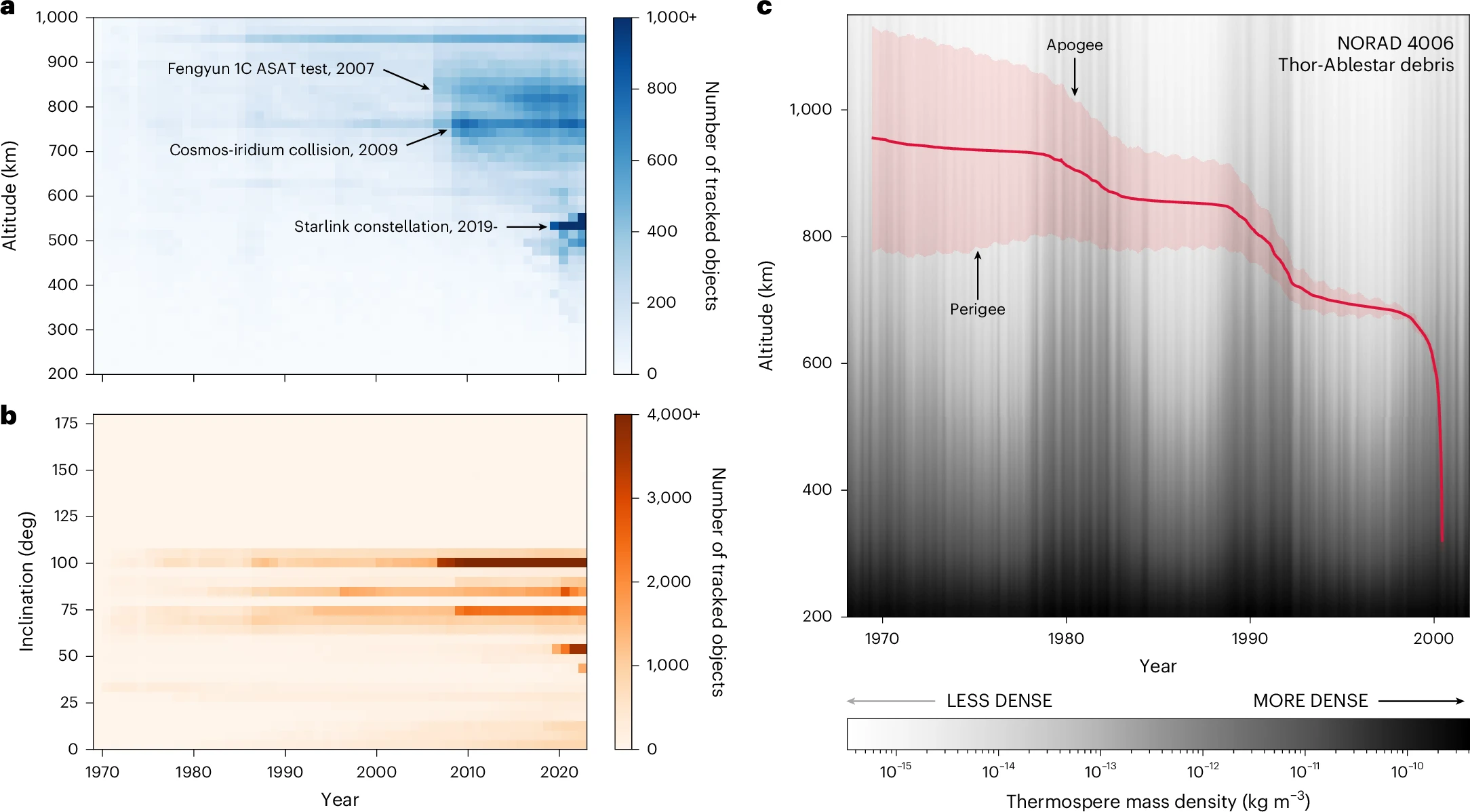 |
| a, Number of tracked objects (>10 cm) by orbit time-averaged altitude and year. Today’s orbital debris environment is largely attributable to two fragmentation events in 2007 and 2009. Existing debris from these events and others represent a hazard to operations in LEO for decades. b, Number of tracked objects (>10 cm) by inclination and year. The same fragmentation events from a are visible in b. c, The trajectory of NORAD 4006 (Thor-Ablestar debris) with thermospheric mass density in the background shows that the drag-induced orbital decay rate is strongly variable and is primarily driven by the 11-year solar cycle. The shaded bounds show the object’s perigee and apogee altitudes. |
Most work done related to greenhouse gas emissions focus on the troposphere, while their effect above the troposphere is often considered minor. Satellites in low Earth orbit are used for communications, weather forecasting, and navigation. While greenhouse gases have a warming effect in the troposphere, they have a cooling effect on the thermosphere. The contraction of the thermosphere resulting from greenhouse gases is likely to cause a reduction in density that will last centuries, making it a significant concern and important to include when modeling projected emissions. For this study, historical data for thermospheric mass density was used to fit a model estimating how different ground-level CO2 concentrations in the future would globally averaged thermospheric mass density. This model considered three scenarios: emissions declining to net zero by 2070 (SSP1-2.6), emissions remaining at current level until 2050 (SSP2-4.5), and emissions doubling (SSP5-8.5). Results found a decrease in density correlating to the 11-year cyclical behavior influenced by solar activity.
 |
Thermospheric mass density at 600 km altitude with a fitted solar cycle projection. |
As object density increases, collisions occur and debris accumulates. New satellites are typically equipped with collision avoidance technology to reduce the risk of collision. The drag acceleration on a satellite is proportional to the atmospheric mass density, which prolongs the lifetime of objects in orbit as density is lower. Recently, the historic 25-year deorbit guideline to remove satellites from orbit at the end of their mission was replaced by guidance for a five-year deorbit timeline to reduce debris accumulation. This study provides the basis for how this deorbit timeline is calculated and how this relies on an assumption of a stable drag coefficient that will change with greenhouse gas emissions, thus making these calculations unreliable.
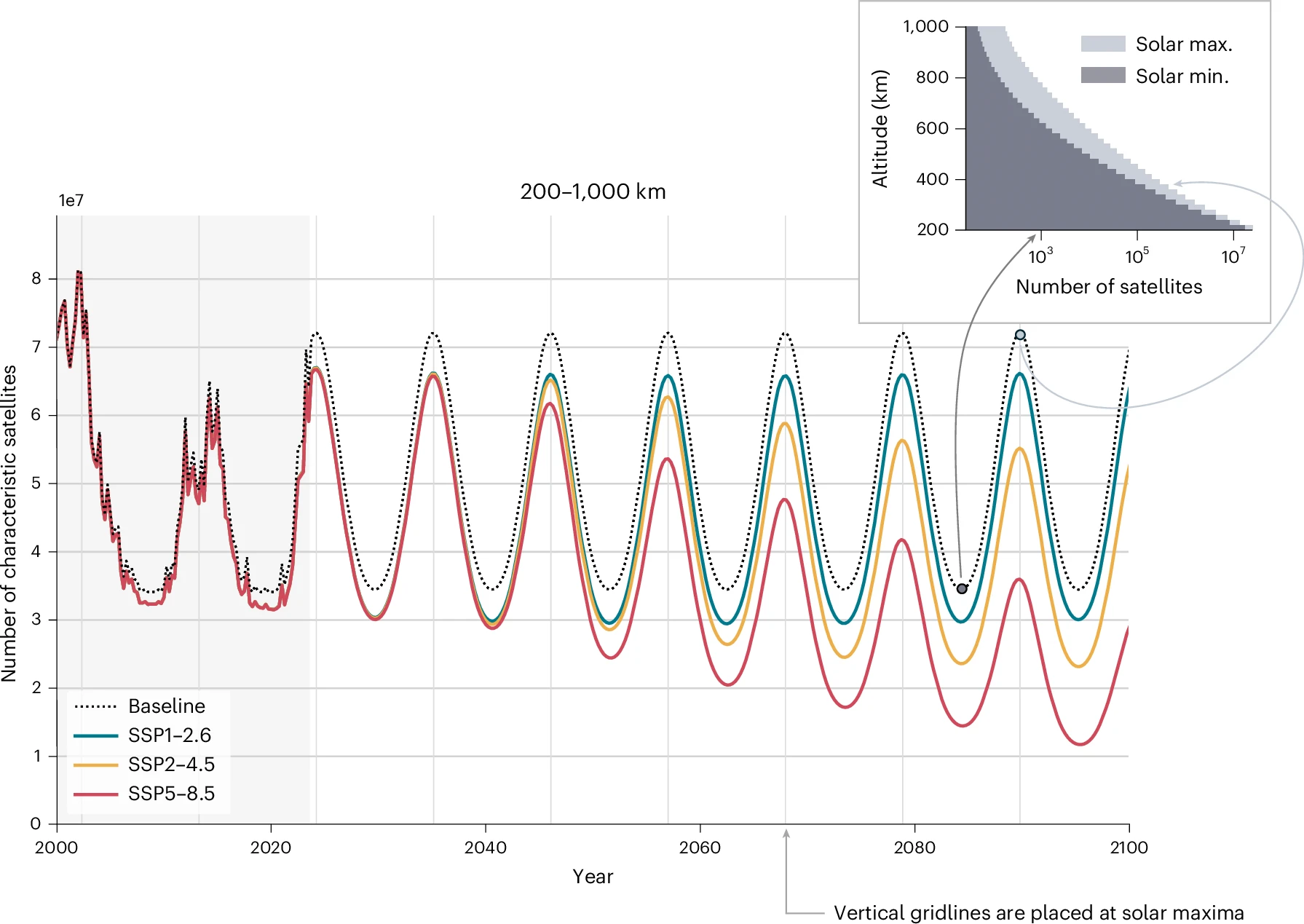 |
| Number of potential orbiting satellites based on emission conditions modeled. |
Score: 8/10
Opinion:
When I review a news article for science communication, I consider how readily accessible it is to the general public while being informative rather than catastrophizing. Having the study’s author interviewed and explaining the research in Layman’s terms gives both credibility to the work as well as clearly communicates findings. While I would have liked to see more background and scientific basis for the impact of greenhouse gas emissions on the atmosphere and its composition, I think the straightforward approach was fitting based on how complex the peer-reviewed paper was. In my efforts to find an interesting news article about atmospheric gases, I also came across multiple press releases and academic outlets describing this study in much more detail. With that in mind, a mainstream news source explained these concepts and the overall impact that greenhouse gas emissions have beyond the Earth’s surface in an easily-digestible format.
Citations:
[1] Roble, R. G. (1983). Dynamics of the Earth's thermosphere. Reviews of Geophysics, 21(2), 217-233.
[2] BATES, R. J. Low Earth Orbit Satellites (LEOs). New York: McGraw-Hill Professional, 2000. Disponível em: https://research-ebsco-com.proxy.lib.umich.edu/linkprocessor/plink?id=5d921552-d67b-3319-8b41-cd0e0edd5065.
[3] Low Earth Orbit Satellites: Potential to Address the Broadband Digital Divide. (2025, September 9). https://www.congress.gov/crs-product/R46896
[4] Ornes, S. (2011, Sep 21). Wanted: Garbage collectors in space. Science News for Kids, Retrieved from https://proxy.lib.umich.edu/login?url=https://www.proquest.com/magazines/wanted-garbage-collectors-space/docview/1114030033/se-2

Great analysis Hunter! I didn't realize that greenhouse gas emissions in the troposphere would lead to cooling of other layers; I assumed there would be warming throughout the entire atmosphere. Something I felt the ABC article missed was an emphasis on the importance of the satellites in Earth's orbit, which, as you mention, are used for communication, weather prediction, research, and more. Without acknowledging the significance of satellites and why so many are needed, I feel that some may not understand why fewer orbiting satellites will be an issue, and thus not take this new finding as seriously. Regardless, I agree with your opinion on the ABC article. The author effectively summarized a complex research article in a way that was very approachable while still communicating the key science discussed in the paper.
ReplyDeleteI agree that the ABC article didn't emphasize the importance of satellites, particularly why so many more are being launched than previously. I personally had never considered what happens to satellites at the end of their lifetime so this article was eye-opening!
DeleteGreat analysis Hunter! I think your point about the shortcomings of the ABC article was insightful, especially the ABCs’ lack of using the projected models as the basis for regulatory recommendations. That seems like an important piece to include because it connects the science directly to policy decisions and shows how greenhouse gas emissions don’t just affect climate but also shape how we manage infrastructure in space. I agree and also appreciate the fact that the ABC article was written to accommodate a general audience, writing for all to grasp the topic, even if it did miss a few key scientific details. The peer-reviewed journal article modeled different emissions scenarios (declining to net zero, doubling, and remaining at the current level). I was wondering if you thought the journal should have touched more on how the three possible futures differ to give the reader, the scientific community, and policy makers more of a sense of urgency? I thought the ABC article could have gone into more detail about what those futures look like to grasp where we are headed if things don't change or get worse.
ReplyDeleteI would have liked to see the article connecting science to policy decisions! While reading the paper, I did consider the three different emissions scenarios to be rather simplified and likely subject to many other factors that are difficult to consider. I definitely think that focusing on a shorter timescale and highlighting potential solutions to reduce greenhouse gas emissions accordingly would be really useful for policy makers.
DeleteThis comment has been removed by the author.
ReplyDeleteHi Hunter, good job on this analysis. I agree with your perspective on the catastrophizing that news outlets participate in when it comes to science communication. I think it can be difficult to express the necessity for urgency in policy change to an audience whose power over that change is relatively minimal without it making it sound like things are hopeless. I agree that the ABC article seemed to do a good job of treading that line. While it certainly could have gone more in-depth about the specifics of the scientific background for the issue, it is good to keep in mind that authors are likely prioritizing readability. This was also a very interesting subject to learn about, it had not occurred to me that satellites could be so significantly affected by the makeup of the atmosphere. I am curious, had you heard about this topic before finding the article for this assignment?
ReplyDeleteI actually had not considered satellites at all, let alone how greenhouse gas emissions could affect them! I happened across it while looking for other ways that greenhouse gas emissions were effecting the atmosphere beyond the troposphere, which most research and public news focus on. I think it will be interesting to see more coming out about upper atmosphere concerns when it comes to greenhouse gases, as it's becoming obvious the time scale/intensity that these layers are affected by emissions is still significant.
DeleteThis is a very interesting study, and a well-written analysis! I agree with your opinion that the article did a good job explaining the science behind the issue while using language that is easy to understand, and I also agree that it would have been nice if they had provided a bit more background about greenhouse gas emissions. I also wish they had potentially extrapolated on how the issue could worsen in the future, like discussing the impacts of losing many satellites as well as some other impacts of the rising amount of debris in the lower orbit, and what would happen if these debris were to remain here for long periods of time. It also could be interesting if the ABC article could have discussed some countermeasures that may have been proposed or implemented and how these could reduce this problem.
ReplyDeleteHi Hunter, great analysis! I agree with your critique about the lack of scientific background in the news piece. The fact that CO₂ cools the thermosphere is counterintuitive and really requires an explanation of the underlying physics to be credible to the public. I noticed that the study's models chose the year 2000 CO₂ level as the baseline. Visualizing the observed CO₂ increase trend (as Prof. Ault showed during class) vs. the thermosphere density decrease trend from 2000-2025 would have made the future projections far more tangible and grounded the threat in empirical data. Additionally, you noted the study renders the deorbit calculations "unreliable," and I agree. It makes me wonder: if we were to factor in a worst-case emissions scenario (SSP5-8.5), what would a realistic passive deorbit guideline even be to be considered safe? Given the atmospheric density loss, would the timeline be less than 5 years (current policy), or is reliable passive deorbit simply not feasible in that future? It seems this might force a universal mandate for active deorbit systems.
ReplyDeleteI definitely agree that a broader look at the CO2 increase trend would be useful to ground how significant this is, and why we would expect future conditions to continue with such a drastic increase rather than what some may consider "relatively normal" based on our own lifetimes.
DeleteWhile looking into the background of satellites within the thermosphere, I did see more recent studies trying to better calculate the "drag" but not necessarily incorporating how policy should lean on these new results. I agree that a more universal policy should be considered, especially considering how drastic a mandate of 25 years being reduced to just 5 must have an impact.
Nice post! I think you started off really strong with the introduction and solidifying what LEOs do and why they operate in the thermosphere. I agree that it's a positive that the ABC article is digestible by a general audience, so that more people can be aware of the basis of this issue. Something that I felt the ABC article could have added is the comparison of 3 different emissions scenarios. I think this emphasizes understanding potential pathways for the future of LEOs. Maybe the ABC could have mentioned what each result would mean and how that would impact daily lives to provide more of a personal connection to the reader? I understand the concern for not presenting an extreme view of catastrophe when it comes to the environment, but I think strides can be shown on how the audience can take action if they wish to. Ultimately, I agree that it is valuable to have an interview with the study's author to show what the goal was with publishing it.
ReplyDeleteI also would have liked a broader view of how this impacts our daily lives, especially considering our reliance on satellites for everything from using GPS to communication. I agree that providing more tangible relationships to this work could help people use this to advocate for lowering greenhouse gas emissions.
DeleteHi Hunter! Great post! I found it fascinating that increasing greenhouse gas emissions reduced the temperature and density of the thermosphere. Like you, I agree that the ABC article did a good job of conveying the main ideas of the article to the public. I especially liked that the ABC article included quotes from Parker, as his explanations with analogies like the balloon in the freezer made the concepts much easier to understand. Your post also encouraged me to think of sustainability in a new way: space sustainability. I thought it was really interesting that the deorbit rule changed from 25 to 5 years. While this change is important to reduce collisions and debris as the thermosphere contracts, I wonder how these more frequent deorbits will affect the Earth? The ABS article included a picture of space debris found in French Guiana, which made me curious about how much space debris will end up scattered around the world as well as the increase in the amount of resources needed to build more LEOs. Ultimately, the best long-term solution would be to reduce greenhouse gas emissions so that deorbit timelines remain longer. How do we balance minimizing debris in space without creating excessive debris on the Earth?
ReplyDeleteI also liked the quotes from Parker and how well he communicated really complex scientific concepts that the ABC article likely wouldn't provide on its own. That's a really interesting point about what an increase in deorbits will look like, even only considering the satellites launched after the switch to a five-year deorbit. I could see this space sustainability issue becoming an environmental concern as more satellites deorbit.
DeleteGreat job on this analysis. Very informative and interesting topic. I really enjoyed reading it!
ReplyDeleteI just had a small question regarding point 3 in your background. You wrote: “As emissions of carbon dioxide rise into the upper atmosphere, the thermosphere cools and becomes less dense.” Intuitively, we might expect that cooling leads to contraction (a decrease in volume) and therefore an increase in density, based on the ideal gas law (PV=nRT), assuming mass remains constant. However, I understand that this may not fully apply here since the upper atmosphere is not a closed system. In this case, it seems that cooling causes the upper atmosphere to contract, but also result in a reduction in atmospheric mass density. Would you mind clarifying how contraction and decreasing density can happen together in this context?
Also, just a very minor terminology question – I believe “drag” might be a bit more precise than “friction” when referring to resistance on satellites in the atmosphere, since drag typically refers to resistance from fluids. Would that be correct in this context?
Hi Frozan, thanks for the question! This is my mistake -- by "becomes less dense," I was trying to convey it's capacity and volume rather than the scientific definition of density. Going back to the ideal gas law is really useful understanding the shifts between layers of the atmosphere, and you're spot on!
DeleteThe paper does use the term drag but doesn't necessarily define it. While looking into this, I came across multiple studies that specifically work to calculate and define the drag that this study references. Drag in this context does refer to the resistance, which satellites are experiencing within the atmosphere and influences their lifetimes.
Thank you for the clarification! Appreciate it!
DeleteHey! I think you did a great strong job showing the differences between the ABC News article and the study. For example, I liked how you noted that the news article simplified the issue by only focusing on how greenhouse gases cool the thermosphere and make debris stay in orbit longer, but left out vital details like the natural expansion and contraction from the solar cycle and the scientific methods used in the study. Your point about the peer reviewed article giving context for why the U.S. changed its guideline from 25 years to 5 years was also really effective, showing how greenhouse gas emissions directly impact space policy and satellite sustainability. I also appreciated how you mentioned how the news article communicated the urgency of reducing greenhouse gas emissions clearly, even if it didn’t provide an in depth background. This balances your critique by showing what the news article did well and where it could have been stronger. Awesome work, Hunter!
ReplyDeleteGood job Hunter! I agree with your rating of 8/10 for the article because I like the length of it and how it is easy to understand. However, it is very clear that the news article that it did not touch on the thermosphere enough, and I noticed that it only referred to it as "upper atmosphere". Do you think that this was oversimplified for the public? I also wish that the news article had discussed the existing satellite regulations that were highlighted in the journal article. It’s important for the public to be aware of these policies so they can understand how satellites are being managed and hold companies accountable for following the rules. Including this information would have made the article even more informative and impactful.
ReplyDeleteHi Hunter, I really enjoyed your analysis! I thought your post articulated the shortcomings of the article very well, and I was especially intrigued by the mention of natural expansion and contraction of the thermosphere due to solar activity. Since the natural rise and fall of the climate is often employed in arguments against climate activism and the ABC article targets a non-scientific audience, I think it would have been valuable if the ABC article had included data that supported the conclusion that greenhouse gases were causing excess contraction of the thermosphere beyond what is caused by fluctuations in solar activity. I'm also curious what you think would be the most relevant scientific data from the peer reviewed article to include in the ABC article? I agree that the article did an excellent job of narrowing down a large amount of information into a digestible piece, but I think adding a few more data points would reduce the "clickbait" aspects that simplified pieces like this often have.
ReplyDeleteHi Hunter, great analysis. I really like how you summarized the paper, especially considering the density of information that came along with it! I completely agree with your overall rating of the ABC article. I had a similar feeling after reading it myself. Most people without daily exposure to science learn about modern research through the news they consume, meaning news articles about recent discoveries are incredible opportunities for scientific communication. The article did a great job of summarizing the big picture finding and its implications, but I think they fall flat on the general science communication front. While I understand that ABC isn't exactly a science news network, I think that the author of this work did a disservice to readers by not going further into the science. It is tough to strike a balance of giving enough background to let people understand without boring them, but some more time going into the structure of the atmosphere (even just so people can learn more about the world around them!) would have been majorly beneficial. Also maybe a few sentences on how the authors found this information out. It's a lot easier to tell your friend about the interesting article you read, and thus spread knowledge of current discoveries, when you understand not only what the research found, but how they found it and what it means. It's the difference between memorizing and understanding. Especially in a time with mistrust in the news, I think providing some discussion of the data that led to this conclusion is crucial for building people's faith in the current state of scientific research!
ReplyDeleteI never would have stopped to consider that increased greenhouse gas emissions could have a potential impact on the orbits of satellites, so I found the articles very interesting in showcasing how greenhouse gases can have such a wide impact and cause a slew of different issues. It was interesting to learn that greenhouse gases can also cause a cooling effect in the thermosphere versus the typical warming effect that we normally associate with greenhouse gases. I think the news article does a good job at effectively summarizing and hitting the main points to the general audience, but I would have liked a little more detail specifically at the end of the article of studying the future effects of if greenhouse gas emissions stayed the same or were significantly decreased. I guess I also would have liked to see the article state briefly on generally what the satellites do in order to understand why this issue is important.
ReplyDeleteHi Hunter! Great analysis overall! This article is so unique in that I have never considered the impacts of greenhouse gases on thermosphere and how that might impact our satellite capacities. I definitely wished that the ABC article honed in a bit more on how this will impact everyday life and individuals overall. The deorbit rule changing from 25 years to 5 years is crucial. Do you think that there should've been a greater discussion on not just the cost analysis of conduct active debris removal, which can cost tens of millions of dollars for a single operation but also of simply deploying a new satellite. For instance, how would that impact tax payers overall? Many times policy-changes are driven by the dollar signs people can attach to them.
ReplyDeleteHello Hunter, this is an extremely interesting analysis. I have never stopped to think that greenhouse gasses could affect the upper atmosphere differently than they affect the troposphere. I also never really considered how they could affect satellites as well. I do wish the article went more into the potential negative consequences of the satellite issue and how that would affect people. The article also mentioned something about that their was a process to remove debris that were already orbiting the earth. I am interested in how this might work and if it could be feasible short term solution to the problem. I also think it would be interesting to go more into the mechanism that causes the thermosphere to cool because it does not really go into a ton of detail there.
ReplyDeleteI think this is a super interesting analysis. I found it interesting that emissions not only effect the conditions on earth but also effect the conditions in space as well. I think it’s interesting the highlight how interconnected space and atmosphere are. The fact that the lowered density of the atmosphere can result in reduced drag allows for stuff to stay in orbit longer and increase the risk of collisions. I like how you highlighted that the news article lacks the details needed to understand the study methods. In my opinion this could be necessary the make the findings understandable for a layman. Overall great work, excited to see you present.
ReplyDeleteHi Hunter, really enjoyed your analysis. I loved that you explored an aspect of the effect of greenhouse gases that maybe doesn't gain as much spotlight. I'm surprised we, as a people, are not putting as much emphasis on the shrinking of the thermosphere since satellite's are less effective because of this continuous shrinkage - especially considering how much it costs to launch and operate each satallite.
ReplyDeleteHi Hunter, I think your analysis was very well thought out! I never really thought about how greenhouse gases would affect satellites. This will probably be very important for policy issue because now a days we all rely on satellites heavily. I also thought it was really interesting that the news article relied on the reader having background knowledge on greenhouse gases. With greenhouse gases being so important in this conversation aI would have thought more background would have been given.
ReplyDelete